7 Heart Rate Mistakes Runners Make When They Think They're Training by Feel
Quick Answer: The most common heart rate mistake is running every ‘easy’ run at 80-90% of max heart rate instead of the intended 60-70%, which happens because perceived effort feels deceptively comfortable at a pace that’s actually too fast — a chest strap monitor for even two weeks usually reveals this gap immediately.
You feel fine. Your breathing’s controlled. And your heart rate is quietly running 20 beats too high for what’s supposed to be a recovery day.

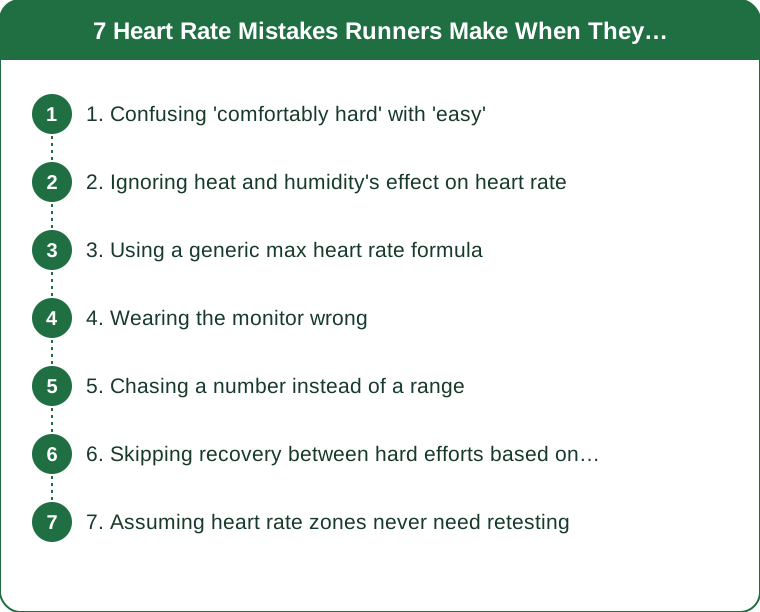
1. Confusing ‘comfortably hard’ with ‘easy’
Most runners’ internal sense of ‘easy’ calibrates to whatever pace they’ve always run, not to an actual physiological zone. If you’ve never trained with a monitor, your easy pace might genuinely sit in zone 3 or 4 without any red flags from perceived effort alone.
The fix is a two-week baseline: wear a chest strap (more accurate than wrist-based optical sensors) on every run and just observe, without adjusting pace yet.
2. Ignoring heat and humidity’s effect on heart rate
The same pace can produce a 10-15 beat higher heart rate on a humid 85°F day versus a dry 60°F day, because your cardiovascular system is working overtime to cool you down on top of moving you forward. Runners who don’t account for this either push through zone drift in summer or panic that their fitness dropped.
3. Using a generic max heart rate formula
The ‘220 minus age’ formula has a documented error margin of plus or minus 10-12 beats per minute, which is enough to put you in the wrong training zone entirely. A field test (or lab test) gives a number specific to your physiology instead of a population average.

4. Wearing the monitor wrong
Wrist-based optical sensors lose accuracy on bony wrists, during arm-heavy movements, and in cold weather when blood flow to the extremities drops — chest straps read the electrical signal directly and are consistently more reliable for training zones, even though they’re less convenient day to day.
5. Chasing a number instead of a range
Heart rate naturally drifts up over a long run even at constant effort (cardiac drift), so treating zone 2 as a single fixed number instead of a 10-beat range leads to constant, unnecessary pace adjustments that undermine the steady aerobic stimulus you’re trying to build.
6. Skipping recovery between hard efforts based on pace instead of heart rate
Pace recovers faster than heart rate does after an interval, so runners who start the next rep once their legs feel ready are often still starting at 85%+ of max — heart rate recovery (dropping to a specific target between reps) is a more honest recovery signal than how your legs feel.
7. Assuming heart rate zones never need retesting
Fitness improvements, illness, poor sleep, and even caffeine intake shift your heart rate response by session — zones set from a test six months ago on a well-rested, well-trained body may no longer match where you are today, especially after a training block or a break from running.
TL;DR:
- ‘Easy’ pace by feel often lands 15-20 beats above true easy zone
- Heat, generic max-HR formulas, and wrist sensor placement all distort readings
- Recover between intervals by heart rate, not by how your legs feel
- Retest zones every few months, especially after a fitness change
A monitor doesn’t replace intuition — it recalibrates it, and most runners are surprised by how much slower true easy actually feels once they see the number.
Keep Reading
This article is for general informational purposes only and is not medical advice. It is not a substitute for professional diagnosis or treatment. Always consult a qualified healthcare provider about your individual situation, especially before making significant changes to your diet or exercise routine.