7 Ways Your Running Route Is Making Training Harder
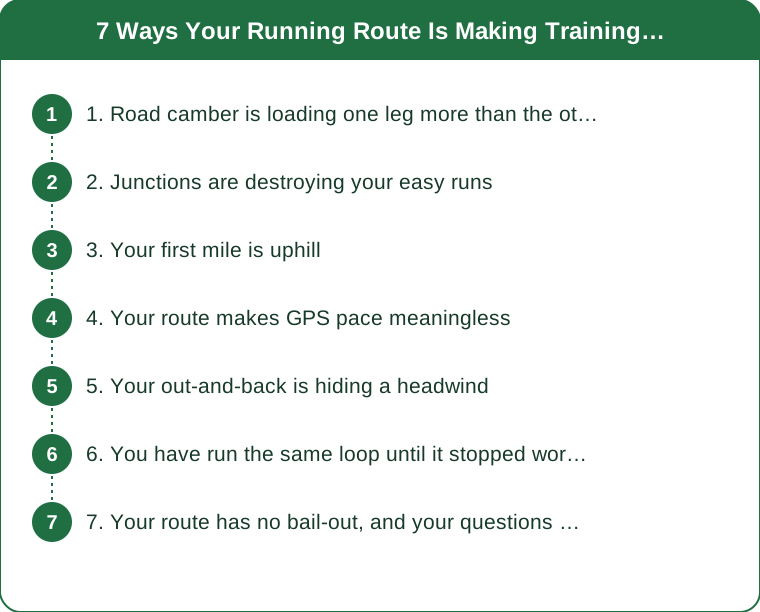
Quick Answer: Seven route problems account for most of what people misattribute to fitness: road camber loading one leg, stop-start junctions destroying easy-run continuity, a hilly first mile that ruins the warm-up, GPS-unreliable terrain that makes pace meaningless, an out-and-back that hides a headwind, running the same loop until it stops adapting you, and a route with no bail-out option that turns every bad day into a full session. Each has a straightforward fix that costs nothing.
Runners will change shoes, plans, and nutrition before questioning the route they have run four times a week for two years.

1. Road camber is loading one leg more than the other
Roads are built with a crown so water drains to the edges. Running on the side of that slope means one leg lands lower than the other on every single stride.
The effects are real and they are one-sided. The downhill leg experiences greater pronation and a functionally longer leg; the uphill leg experiences the reverse. Over hundreds of miles this asymmetry contributes to one-sided IT band, hip, and Achilles complaints.
It is a common and overlooked contributor to injuries that appear on one side only. If your niggle is always the same leg, the surface is worth examining before your gait is.
The fix: use pavements and paths where possible, which are generally flatter than road crowns.
On out-and-back routes, you naturally run both sides, which cancels much of it. On a loop always run in one direction, you do not - so alternate the direction of your regular loop week to week.
And where you must run on a cambered road, move towards the crown when it is safe. The middle of the lane is the flattest part of the road, though safety comes first and this is only viable on quiet roads with good visibility.
2. Junctions are destroying your easy runs
An easy run works through continuous low-intensity effort. Stopping every four minutes at a crossing breaks it into fragments, and the physiological adaptations of a continuous 45-minute effort are not the same as those of twelve four-minute efforts with rests.
Heart rate never settles. Each restart produces a spike, so the average is higher and the actual sustained aerobic time much lower than the total suggests.
It also makes pace data useless. Standing at a light drags your average pace down, so people run the moving sections faster to compensate - which turns an easy run into an interval session by accident. This is one of the most common ways easy runs stop being easy.
The fix: build easy runs on continuous routes - parks, riversides, canal paths, industrial estates on a Sunday.
Use junction-heavy routes for the sessions where stopping does not matter, such as a warm-up jog to a track or a deliberate run-walk session.
And if you cannot avoid stops, run to effort and ignore average pace entirely on those runs. The number will be misleading regardless of what you do.
3. Your first mile is uphill
The first ten to fifteen minutes of a run is a physiological transition - blood flow redistributing, tissue warming, breathing pattern settling. Loading a climb into that window makes it worse, not more efficient.
It makes every run start badly, which is a motivational cost more than a physical one. Runs that start hard are the ones people skip.
It also inflates your perceived effort for the entire session. Starting above the intended effort colours the rest of the run and the way you remember it.
The fix: flip the route. Run the loop in the opposite direction so the climb sits at 20 to 30 minutes, when you are properly warm.
Or add five minutes of flat before the hill starts, even if that means an out-and-back stub at the beginning.
Hills at the start are useful in exactly one context - a race that has one. In that case it becomes course-specific practice rather than a route problem, and you should keep it.

4. Your route makes GPS pace meaningless
Tree cover, tall buildings, tunnels, and steep valleys all degrade GPS accuracy substantially. In dense woodland or a city centre, instant pace can be off by a large margin.
The result is chasing a number that is not real. Runners speed up and slow down responding to GPS noise, producing an uneven effort on what should be a steady run.
Distance is affected too, and a route through woodland can measure several percent long or short compared with the same route in the open.
The fix: use effort or heart rate on these routes and treat the watch as a stopwatch.
Switch the display to lap pace or average pace rather than instant pace, both of which are far more stable.
And note autumn changes this. Leaf cover thins from October, so a wooded route that was GPS-unreliable in August becomes considerably more accurate by November. If your paces on a familiar wooded route suddenly look different this autumn, check the satellite reception before concluding anything about your fitness.
5. Your out-and-back is hiding a headwind
Wind is the most underestimated variable in running, and an out-and-back with a steady wind produces an easy first half and a brutal second half.
Runners consistently misread this as fading fitness. The classic pattern is a first half comfortably at pace and a second half that feels impossible, on a day where nothing else was wrong.
Headwind costs far more than tailwind gives back, so a windy out-and-back is always net slower than the same route on a still day.
The fix: run into the wind on the way out. You finish with assistance rather than against a wall, and it makes long runs materially more manageable.
Check the wind direction before you leave rather than discovering it at the turnaround.
On loops, wind averages out over the run, which is one of the underrated advantages of a loop over an out-and-back on exposed routes. Autumn brings noticeably more wind than late summer in most temperate places, so this becomes more relevant from September onwards.
6. You have run the same loop until it stopped working
The body adapts to specific demands, and a single unchanging route provides a narrow set. Same surface, same gradients, same turns, same cadence.
Movement variability is protective. Varied surfaces and gradients distribute load across tissues differently, and monotonous loading is associated with overuse injury.
It also degrades your pacing sense. Running one route makes you good at that route rather than good at judging effort, which shows up on race day.
And the psychological cost is real - route boredom is one of the most common reasons people stop running, and it is entirely avoidable.
The fix: keep two or three routes in rotation, ideally with different surfaces - one road, one trail or park, one mixed.
You do not need new routes, just alternation. Running your usual loop in the opposite direction is a genuinely different run: different climbs, different camber, different turns.
7. Your route has no bail-out, and your questions answered
A single large loop commits you to the whole distance from the moment you leave. Feeling unwell at the far point of a 15km loop means running 8km home regardless.
This causes people to skip runs entirely on marginal days, because the choice is all or nothing rather than something or nothing.
It matters more in autumn and winter, when weather changes fast, darkness arrives suddenly, and a route that was fine in July is a different proposition in November.
The fix: design routes as repeatable smaller loops - three 5km laps rather than one 15km loop. It sounds less appealing and it makes the session flexible, and flexible sessions get done.
Or use an out-and-back, where you are never more than halfway from home at any point.
Keep one short route in reserve for days when a full session is not happening. A 20-minute easy run you actually do beats a 60-minute run you skip.
Is running on pavement worse than road?
Pavements are usually flatter, which is better for camber. Surface hardness differences between concrete and asphalt are much smaller than commonly claimed - camber matters more.
How much does wind actually cost?
Enough to fully explain a bad second half on an out-and-back. Headwind costs more than tailwind returns, so windy days are net slower regardless of route.
Should I run the same route to track progress?
One benchmark route is useful for comparison. Making it your only route is where the problems above start.
TL;DR:
- Road camber loads one leg more than the other - if your niggle is always the same side, check the surface before your gait.
- Junctions fragment easy runs and corrupt average pace, which is how easy runs quietly turn into intervals.
- Flip a route that starts uphill so the climb lands at 20 to 30 minutes when you are warm.
- Run into the wind on the way out of an out-and-back, and expect GPS to lie under tree cover and between buildings.
- Keep two or three routes in rotation and build routes with a bail-out - flexible sessions are the ones that actually get done.
Running your usual loop in the opposite direction is a genuinely different run, and it costs nothing.
Keep Reading
This article is for general informational purposes only and is not medical advice. It is not a substitute for professional diagnosis or treatment. Always consult a qualified healthcare provider about your individual situation, especially before making significant changes to your diet or exercise routine.