7 Running Cues That Backfire and What to Use Instead
Quick Answer: A good cue changes one thing indirectly and lets the rest reorganise around it. A bad cue asks you to consciously control a joint position that should be an outcome, which produces tension, breaks your natural rhythm, and often creates a new problem worse than the one you were fixing. Land midfoot, drive your knees, and pump your arms are all descriptions of outcomes being misused as instructions. The replacements below all work the same way: change the target, let the form follow.
If a cue makes you think about a body part while you run, it is probably the wrong cue.

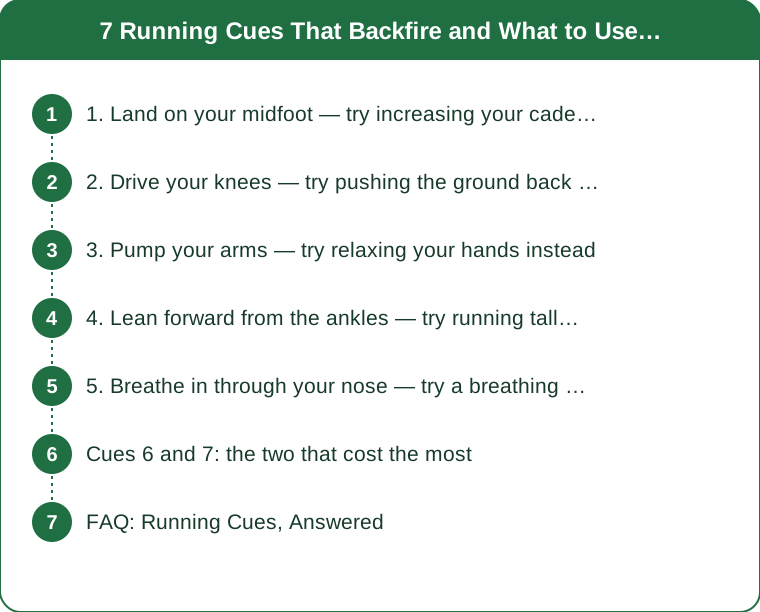
1. Land on your midfoot — try increasing your cadence instead
Why it backfires: foot strike is an outcome of where your foot lands relative to your body, not something you can usefully control at the ankle. When people consciously try to land midfoot, they typically reach forward and slap the foot down flatter, which is overstriding with a different contact point. The braking force stays, and now the calf and Achilles are absorbing more of it than before.
The result is a very common pattern: someone switches to midfoot on purpose, reports feeling smoother for a week, then develops calf tightness or Achilles soreness that they attribute to the transition being incomplete. It usually was not incomplete. It was the wrong lever.
What to use instead: increase your step rate by roughly five percent. If you currently run at 160 steps per minute, aim for 168. Use a metronome app or a playlist at that tempo for the first few weeks.
Raising cadence shortens your stride slightly, which brings your foot down closer to underneath your hips. Foot strike then changes on its own, without you thinking about your foot at all, and the braking force drops with it. Studies of cadence manipulation consistently show reduced load at the knee and hip with modest increases.
The check: you should feel like you are taking quicker, lighter steps, not like you are working harder. If your heart rate jumps significantly, you sped up rather than increasing turnover.
2. Drive your knees — try pushing the ground back instead
Why it backfires: knee drive is prominent in sprinting and largely irrelevant at distance pace. Consciously lifting the knees at an easy or steady effort raises the centre of mass more than necessary, increases vertical oscillation, and burns energy going up rather than forward. It also tends to produce a reaching action, which puts the foot ahead of the body again.
Runners who adopt this cue often describe feeling bouncy and powerful for a mile and then unusually fatigued. That is the vertical work showing up in the metabolic cost.
What to use instead: think about pushing the ground backwards behind you. The emphasis moves from the front of the stride to the back, from lifting to propelling.
This single change tends to improve hip extension, which is the actual quality most distance runners lack. Better hip extension means more propulsion per step, less reliance on reaching, and better glute recruitment, which is precisely what desk-based lifestyles erode.
The check: ask someone to film you from the side. You are looking for the trailing leg to extend behind you, with a visible angle behind the vertical, before it swings through. If the leg leaves the ground still bent under you, hip extension is missing.
3. Pump your arms — try relaxing your hands instead
Why it backfires: arm action should be a rhythmic counterbalance to leg action, not an independent power source. Deliberately pumping the arms creates upper-body tension that travels to the shoulders and neck, raises the shoulders toward the ears, and often causes the torso to rotate more, which wastes energy sideways.
It also has a metabolic cost that people underestimate. Upper-body muscles working harder than they need to compete for blood flow and oxygen with the legs, which are doing the actual job.
What to use instead: relax your hands as though holding something fragile, and let your shoulders drop away from your ears. That is the entire cue.
Relaxed hands cascade upward. Loose fingers make loose wrists, which make loose forearms, which make dropped shoulders. Arm swing then finds its own amplitude, which will roughly match your cadence because it is being driven by the legs.
The check: every ten minutes, drop your arms and shake them out for three seconds, then let them return. Whatever position they return to naturally is close to correct. If they return noticeably lower and looser than where they were, you were holding tension.

4. Lean forward from the ankles — try running tall instead
Why it backfires: the forward lean of efficient running is small, roughly two to five degrees, and it comes from the whole body slightly ahead of the foot, not from an intentional posture. Told to lean, most people either bend at the waist, which shuts down hip extension and compresses breathing, or push the hips back, which is the opposite of the intent.
Bending at the waist is particularly costly because it puts the centre of mass behind the hips, guaranteeing that the foot lands ahead of the body. The cue produces the exact fault it was meant to prevent.
What to use instead: run tall, with the crown of your head reaching upward, and imagine your hips travelling forward with you.
Running tall opens the hip flexors, allows full hip extension, and creates the small natural lean automatically because a tall posture with forward momentum is already slightly ahead of the contact point. It also opens the diaphragm, which matters more as effort rises.
The check: if your lower back aches after runs, or if you feel your breathing is restricted at moderate effort, posture is a strong candidate. Both improve within a couple of weeks of running tall.
5. Breathe in through your nose — try a breathing rhythm instead
Why it backfires: nasal breathing is a legitimate tool for very easy running and for training tolerance to carbon dioxide, and it is a genuine limitation at moderate and hard efforts. Airflow through the nose is roughly half of what the mouth allows. Insisting on it at tempo pace means running at a lower intensity than you intended while believing you are being disciplined.
It also produces a specific unpleasant experience that people misread as fitness: air hunger, rising anxiety, and a feeling of not being able to get enough in. That is a mechanical restriction, not an aerobic limit.
What to use instead: use a breathing rhythm tied to your steps. A three-step inhale and two-step exhale for easy running, two-and-two for harder efforts, through whichever opening moves enough air.
Rhythmic breathing does two useful things. It regulates effort, because you notice immediately when you cannot hold the pattern. And the odd-numbered pattern alternates which foot lands at the start of each exhale, which distributes the impact of exhalation across both sides rather than loading one side repeatedly.
The check: if you can hold a 3:2 rhythm comfortably, you are in an easy zone. When it naturally collapses to 2:2, you have crossed into moderate. This is a more useful effort gauge than most watch metrics.
Cues 6 and 7: the two that cost the most
6. Take longer strides to run faster — try holding form and adding turnover
Why it backfires: speed is stride length times stride rate, so lengthening the stride does technically increase speed, right up until it does not. Lengthening deliberately means reaching, and reaching means landing with the foot well ahead of the centre of mass, which creates a braking force with every step.
So you get faster for a short distance while paying a compounding cost in impact and inefficiency. It is also the single most reliable way to produce shin pain, because the tibialis anterior works overtime controlling the foot down from an extended reach.
What to use instead: keep your form identical and increase your turnover. Stride length will lengthen on its own as you get stronger and as your hip extension improves, and when it does, it lengthens behind you rather than in front.
This is why elite runners have long strides but do not reach. The length is generated by propulsion, not by extension of the lead leg.
The check: film from the side at your target pace. At the moment of contact, the foot should land close to under the hip and knee, not out in front with a straightened leg.
7. Push through the pain — try naming what the pain is instead
Why it backfires: this cue lumps together two categories that need opposite responses. Discomfort from effort, burning legs, heavy breathing, general fatigue, is safe and is exactly what training feels like. Pain that is sharp, localised, one-sided, or that changes your gait is information about tissue, and continuing through it is how a manageable irritation becomes a six-week absence.
Autumn is when this bites hardest, because training volume often rises after a summer of inconsistency and people apply summer’s tolerance to a body that lost some of its capacity.
What to use instead: run a quick classification when something hurts. Is it symmetrical or one-sided? Diffuse or pinpoint? Does it improve as you warm up or worsen? Does it change how you run?
Symmetrical, diffuse, improves with warming, no gait change: continue and monitor. One-sided, pinpoint, worsens with distance, or you are visibly compensating: stop the session and reassess. That second cluster is the one worth taking seriously, and pain that persists at rest, wakes you at night, or does not settle within a few days should be assessed properly rather than run through. This is general information, not medical advice.
The check: if you would be embarrassed to describe your reasoning out loud to a physiotherapist, that is usually the answer.
FAQ: Running Cues, Answered
How long does it take a new cue to become automatic?
Roughly four to six weeks of consistent easy running. Introduce one cue at a time and only during easy runs, since hard efforts default to old patterns.
Should I change my form at all if I have no pain?
Probably not, beyond cadence. Self-selected form is usually close to metabolically optimal for the individual, and changing it without a reason often makes things worse before they get better.
Is 180 steps per minute really the target?
No. That number came from observing elites at race pace and was never a universal target. Increasing your own cadence by five percent is the useful version.
Can I work on more than one cue at once?
Not effectively. Attention is the limiting resource, and two cues usually means neither one embeds.
Do running shoes fix form problems?
They change the loading pattern, which sometimes relieves a symptom, and they do not change where your foot lands relative to your body. Cadence does that.
TL;DR:
- Good cues change one input indirectly. Bad cues ask you to consciously control an outcome.
- Raise cadence five percent instead of trying to land midfoot.
- Push the ground back instead of driving knees; relax your hands instead of pumping arms.
- Run tall instead of leaning; use a 3:2 breathing rhythm instead of forcing nasal breathing.
- Add turnover instead of lengthening stride, and stride length comes on its own.
- Classify pain as symmetrical-and-diffuse versus one-sided-and-pinpoint instead of pushing through everything.
One cue at a time, on easy runs only, for a month. That is the whole method.
Keep Reading
This article is for general informational purposes only and is not medical advice. It is not a substitute for professional diagnosis or treatment. Always consult a qualified healthcare provider about your individual situation, especially before making significant changes to your diet or exercise routine.