7 Reasons Your Easy Pace Suddenly Got Faster in Late August
Quick Answer: If your easy pace jumped 20 to 45 seconds per mile at the same effort in the last two weeks, the biggest single driver is almost certainly the drop in heat and humidity, followed by the plasma volume you built acclimatizing over summer, which is still working for you in cooler air. Real fitness gains are in there too, but they are the smaller share. The practical consequence: enjoy it, do not immediately reset your training paces around it, and expect part of it to give back within a few weeks as heat acclimatization unwinds.
You went out for the same easy run you have done all summer, kept the effort honest, and came back to a number that looked like a mistake.
Seven things are contributing. Two of them you should bank, three of them are temporary, and two of them are worth checking before you get too pleased with yourself.

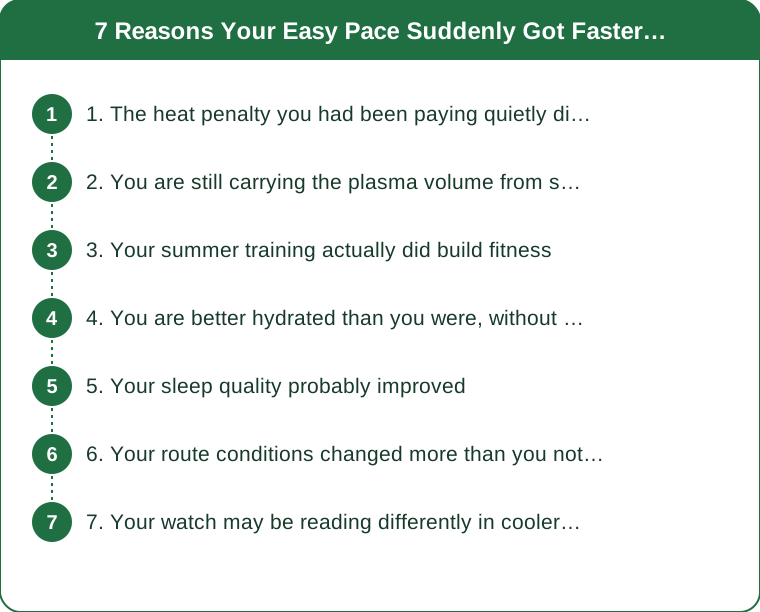
1. The heat penalty you had been paying quietly disappeared
This is the largest single factor and it is not close.
Running in heat costs pace. The commonly used estimates put the penalty at roughly 2 to 3 percent slower per 10 degrees F above about 60F, and that compounds - a run at 85F with high humidity can cost well over a minute per mile compared with the same effort at 60F.
The mechanism is straightforward. Blood that goes to the skin for cooling is blood not available to working muscle, so at any given pace your heart rate is higher and your sustainable output is lower. Add humidity, which slows sweat evaporation, and the cooling itself becomes less efficient.
Humidity is the part people underestimate. Dew point tracks the actual cost better than temperature - once dew point climbs above about 65F, effort at a given pace rises sharply, and above 70F most runners are simply running a different sport.
So the first thing that happened in the last fortnight is that a tax you were paying on every single run got smaller. Not a gain. A refund.
How to tell how much of your jump is this: compare the dew point on a run three weeks ago against one this week. A twenty degree drop in dew point plausibly accounts for most of a thirty second per mile improvement on its own.
2. You are still carrying the plasma volume from summer
Heat training built a real adaptation, and for a few weeks you get to use it in good conditions.
Repeated heat exposure over one to two weeks expands plasma volume - the fluid part of your blood. More blood volume means more blood returning to the heart, more stroke volume, and a lower heart rate at any given pace.
This is why heat training is sometimes used deliberately as a poor person’s altitude camp. The adaptation is genuine, and it is measurable in performance terms.
The window right now is the sweet spot: you have the adaptation and you no longer have the heat that caused it. That combination is why late August and early September so often produce surprising easy runs.
The catch is that it decays. Plasma volume starts returning toward baseline within days of heat exposure ending, and much of the gain is gone in two to three weeks. So this contribution is real but borrowed.
If you want to keep part of it, some runners keep one weekly session in warmer conditions - a midday run, or overdressing slightly - through September. Whether that is worth the discomfort depends on whether you have an autumn race that matters.
3. Your summer training actually did build fitness
Some of this is the thing you were hoping it was.
A full summer of consistent aerobic running does build durable adaptations: capillary density, mitochondrial content, stroke volume, running economy, and the metabolic machinery of fat oxidation. These are slow adaptations, they accumulate over months, and unlike plasma volume they do not evaporate in a fortnight.
The tell is consistency across different conditions. If your pace improved on cool mornings, warm evenings, hills and flats alike, that is fitness. If the improvement appears only on cool days, it is weather.
A second tell is heart rate at easy effort over time. If your average heart rate on genuinely easy runs has trended down over the summer at similar paces and similar conditions, that is a real aerobic gain.
A third is durability. Fitness shows up in the last third of a long run more clearly than in the first mile. If the final miles of your long runs have stopped falling apart, that is not the weather.
Realistically, in a two week window where conditions changed dramatically, fitness is likely the smaller share of the jump. Over a full summer it is the part that will still be there in November.

4. You are better hydrated than you were, without trying
Chronic low-grade dehydration through a hot summer costs more than most runners think.
Losing even 2 percent of body mass as fluid is associated with a measurable drop in endurance performance and a rise in heart rate at a given workload. Through a hot summer, many runners start runs already slightly down, because overnight losses are larger and daytime intake does not fully keep up.
Cooler weather reduces sweat rate substantially, and you start more runs at genuine baseline hydration. That alone can be worth several beats per minute and a chunk of pace.
There is a trap here for the next few weeks. Thirst drive falls in cool weather while sweat losses are still meaningful, particularly on longer runs. The autumn pattern is under-drinking without noticing, and it shows up as a run that felt fine for forty minutes and fell apart at fifty.
Practical check: weigh before and after a long run once in September. More than about 2 percent lost means your intake needs adjusting for the new season, even though it feels cool.
5. Your sleep quality probably improved
Cooler nights are a genuine performance intervention and nobody counts them.
Core temperature needs to fall for sleep to initiate and consolidate. Hot bedrooms measurably fragment sleep, reducing slow wave sleep in particular - which is the phase most associated with physical recovery.
A run of cooler nights at the end of August frequently produces the first properly restorative sleep in weeks. Better sleep improves reaction time, perceived exertion, glycogen resynthesis and mood, and reduced perceived exertion alone will make the same pace feel easier - which then makes an easy run faster, since easy is calibrated by feel.
This one is worth protecting deliberately. It is also the cheapest performance gain in the list.
If your improvement coincided with the first week you stopped waking at 3am hot, that is not a coincidence and it is not a small effect.
6. Your route conditions changed more than you noticed
Some of the jump is not you at all.
Surface firmness changes seasonally. Trail and grass that were soft and dusty in August firm up with autumn moisture, and firmer ground returns more energy. Conversely, wet leaves later in the season will slow you down again.
Wind patterns shift, and a route with a prevailing summer headwind can quietly become neutral.
You may be running at a different time of day. As mornings cool, many runners move sessions earlier or later, and body temperature rhythm means most people are physiologically fastest in late afternoon and slowest first thing. A shift in run timing can move pace by a noticeable margin in either direction.
And crowding changes. Paths that were busy through August school holidays empty out, and there is a real cost to weaving through foot traffic that disappears from your splits when the traffic does.
Check your GPS elevation and route data across the comparison runs before assigning any of this to fitness. It takes two minutes and it prevents a false conclusion.
7. Your watch may be reading differently in cooler weather
A small factor, but it is not zero, and it points the same direction as everything else.
Optical wrist heart rate sensors are less accurate on cool skin. Peripheral vasoconstriction in cooler air reduces blood flow at the wrist, and the sensor has less signal to work with. The common failure is a reading that lags or reads low, which makes an effort look easier than it was.
If you are calibrating easy runs by heart rate, an under-reading sensor means you run faster to hit the same number - and the pace improvement is partly an artifact.
GPS also behaves differently with foliage and weather, and while modern multi-band units are good, dense summer tree cover versus thinning autumn cover can shift distance measurement on the same route by a small percentage.
The fix is a chest strap for any run where the data matters, and a known-distance check - a track, or a measured segment - once at the start of the season.
The honest summary of all seven: the improvement is real in your experience of the run, mostly environmental in its cause, partly durable, and not a reason to rewrite your training paces yet. Wait three weeks, then set your autumn paces from a proper test rather than from the best easy run of the year.
TL;DR:
- Heat and humidity were costing you 2 to 3 percent per 10F above 60F - the biggest share of the jump is a refund, not a gain.
- Summer plasma volume is still working for you in cool air, but it decays within two to three weeks.
- Real fitness is in there, and the tell is improvement across all conditions plus better final miles on long runs.
- Better hydration and cooler-night sleep are both quietly large and both easy to lose again.
- Route, timing and surface changes account for more than most runners check.
- Cool skin degrades wrist heart rate accuracy, which can flatter your effort.
- Do not reset your training paces yet. Wait three weeks and test properly.
Enjoy the fast easy runs. Just do not build an autumn training block on the assumption that all of it belongs to you.
Keep Reading
This article is for general informational purposes only and is not medical advice. It is not a substitute for professional diagnosis or treatment. Always consult a qualified healthcare provider about your individual situation, especially before making significant changes to your diet or exercise routine.