7 Reasons Your First Mile Always Feels the Worst
Quick Answer: The first mile is genuinely harder, not imagined. Your body is still switching fuel systems, your oxygen delivery lags behind demand (the oxygen deficit), muscles and tendons are cold and stiff, blood is still being redistributed from your organs to your legs, and breathing rhythm has not synchronized with your stride. Most runners feel a real shift between minute 8 and minute 12. You cannot eliminate it, but you can shrink it - mostly by starting slower than feels right and warming up before you start the clock.
The runners who look effortless from step one are almost all doing something before you see them.

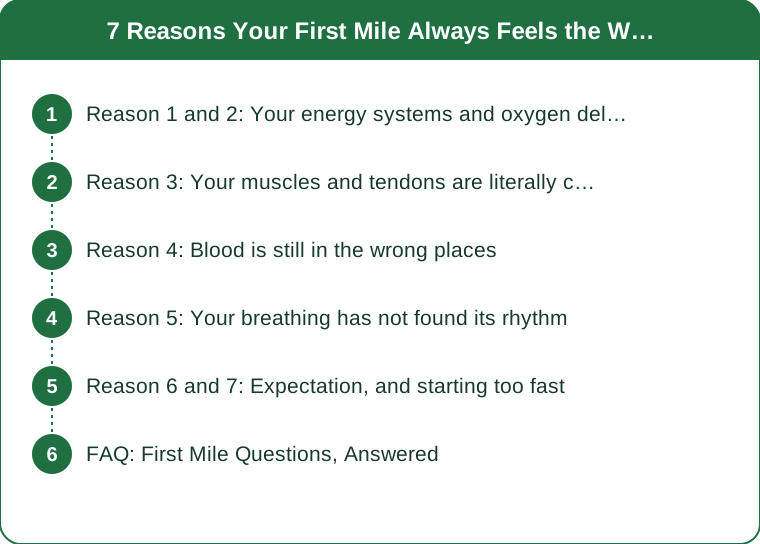
Reason 1 and 2: Your energy systems and oxygen delivery are both behind
1. You are still switching fuel systems
At rest, your muscles run largely on fat and stored ATP. When you start running, demand jumps immediately, but the aerobic system takes several minutes to ramp up. In the meantime your body leans on anaerobic pathways, which produce energy quickly and generate metabolic byproducts that make the effort feel disproportionately hard.
This is the source of the heavy-legged, slightly panicked feeling in the first half mile even at an easy pace. Nothing is wrong; the system that will carry you for the next hour has simply not finished starting up.
2. Oxygen delivery lags behind oxygen demand
This lag has a name: the oxygen deficit. Your muscles need oxygen the moment you start, but heart rate, stroke volume, breathing rate, and blood redistribution all take minutes to reach the required level.
During that window you are effectively running on credit, and the debt is repaid as your cardiovascular system catches up. This is why heart rate often spikes early then settles - once delivery matches demand, the same pace suddenly costs less.
Practical implication for both: the first mile at a slower pace shortens the deficit substantially. Running it fast makes the whole run harder, not just the first mile.
Reason 3: Your muscles and tendons are literally colder
Tissue temperature affects performance more than most runners appreciate.
Cold muscle contracts less efficiently. Enzyme activity, nerve conduction velocity, and the speed of contraction all improve a few degrees above resting temperature. A cold muscle produces less force for the same effort.
Tendons are stiffer when cold, and stiffness is not free. Running relies heavily on elastic energy return through the Achilles and the whole posterior chain. Cold tendons return less energy per stride, so you pay more metabolically for the same pace.
Synovial fluid in the joints is more viscous when cold, which is the source of the creaky, clunky feeling in the first few minutes - especially in ankles and knees.
This is why the effect is worse in autumn and winter. Starting a run at 8°C rather than 22°C means starting from a considerably lower tissue temperature and needing longer to reach working temperature. Add three to five minutes to your warm-up from September onward.
The fix: five minutes of walking or dynamic movement before you start running, and beginning the run itself slower than target pace. Static stretching before a run does not help here and can slightly reduce power output.
Reason 4: Blood is still in the wrong places
At rest, a large share of your blood supply is servicing your digestive organs and other tissues rather than your legs.
Redistribution takes minutes. When you start running, blood vessels in the working muscles dilate and vessels elsewhere constrict, shifting flow toward the legs. Until that shift completes, your muscles are underperfused relative to demand.
Eating beforehand makes it worse. Digestion pulls blood to the gut and competes directly with running muscle. A meal within an hour of starting produces a noticeably rougher first mile, and is one of the more common causes of an early stitch.
Sitting all day before an evening run compounds it. Prolonged sitting reduces circulation to the legs and leaves hip flexors shortened. The 5pm run after eight hours at a desk is the hardest first mile of the week for most people, and it is worth knowing that so you stop reading it as declining fitness.
Morning runs have their own version. Overnight you are mildly dehydrated, core temperature is at its daily low, and spinal discs are more hydrated and stiff. Everything is a bit tighter and a bit slower to respond.
The fix: a few minutes of walking, leg swings, and easy movement gets redistribution started before the running does. If you run after work, spend the last five minutes before the run moving rather than sitting in the car.

Reason 5: Your breathing has not found its rhythm
Breathing during running is not fully automatic - it locks to stride, and that lock takes time to establish.
Most runners settle into a rhythmic pattern - commonly three steps per inhale and two per exhale at easy paces, though it varies. That coupling improves efficiency and reduces the sensation of effort.
In the first minutes it has not synchronized. Breathing is faster and shallower than needed, which feels like breathlessness even at a pace you could hold for an hour.
Shallow breathing recruits the wrong muscles. Chest-dominant breathing uses accessory muscles and tires them, while diaphragmatic breathing moves more air with less work. Early in a run, most people are chest breathing without realizing it.
Cold or dry air makes it worse. Autumn mornings mean cooler, drier air, which irritates airways and can make the early breathlessness feel disproportionate. This is also when exercise-induced bronchoconstriction is most commonly noticed, and it is worth mentioning to a doctor if breathing is genuinely difficult rather than just unsettled.
The fix: deliberately slow, deep breaths for the first few minutes. Count a rhythm consciously until it takes over on its own - and if you are running in cold air, a buff over the mouth for the first mile genuinely helps.
Reason 6 and 7: Expectation, and starting too fast
6. Your brain is comparing this to your best run
The first mile is where you check whether today is a good day, and the reference point is usually your best recent run rather than your average one. A perfectly normal first mile compared against an exceptional memory feels like failure.
There is also a genuine perceptual effect: effort feels highest when it is unfamiliar within a session. Ten minutes in, your perception recalibrates to the current effort and the same pace feels easier - the pace did not change, your reference did.
7. You are almost certainly starting too fast
This is the most fixable item on the list and the most common. Fresh legs and no accumulated fatigue mean the first mile feels like it should be quick, so runners start at or above goal pace, deepen the oxygen deficit, and spend the next two miles paying for it.
Start the first mile 30 to 60 seconds per mile slower than goal pace. Almost every experienced runner does this, and almost every frustrated beginner does not.
A useful test: if your first mile is your fastest mile of an easy run, you started too fast - regardless of how it felt.
The negative split habit is the practical form of this. Run the second half faster than the first, deliberately, and both the first mile and the whole run get easier.
FAQ: First Mile Questions, Answered
How long should a proper warm-up be?
Five to ten minutes of walking and dynamic movement before an easy run; ten to fifteen minutes of easy running plus a few short accelerations before a hard session or race. Longer in cold weather.
Should I walk before I run?
Yes, and it is underrated. Three to five minutes of brisk walking raises tissue temperature, starts blood redistribution, and mobilizes joints without adding fatigue. It makes the first running mile noticeably better.
Does the first mile get easier as you get fitter?
Somewhat. Fitter runners transition faster and have a smaller oxygen deficit at a given pace. But the effect never disappears entirely, and elite runners warm up more thoroughly than anyone else precisely because of it.
Is it normal for my legs to feel heavy for the first ten minutes?
Common and usually normal, especially in the morning, after sitting, or in cold weather. Heaviness that persists through an entire run, across multiple runs, is different and usually points to inadequate recovery, low iron, or accumulated fatigue - worth investigating rather than pushing through.
This is general information, not medical advice. Chest pain, unusual breathlessness, or dizziness during running should be assessed by a healthcare professional.
TL;DR:
- The first mile is genuinely harder: fuel system switching, oxygen deficit, cold tissue, blood redistribution, and unsynchronized breathing all stack in the same window.
- Expect the shift between minute 8 and 12, and expect it to take longer in autumn cold.
- The two biggest fixes: walk and move for five minutes first, and start 30 to 60 seconds per mile slower than goal pace.
- If your first mile is your fastest mile of an easy run, you started too fast.
What changes once you understand this is how you interpret it. That awful opening mile is not evidence about your fitness, your training, or your day - it is a transition every runner goes through, and the only real question is whether you spend it patiently or spend the rest of the run paying for it.
Keep Reading
This article is for general informational purposes only and is not medical advice. It is not a substitute for professional diagnosis or treatment. Always consult a qualified healthcare provider about your individual situation, especially before making significant changes to your diet or exercise routine.