7 Reasons Your Running Watch and Your Legs Disagree
Quick Answer: A mismatch between watch data and perceived effort usually comes from a measurement problem, a physiological lag, or an accumulated fatigue effect. Wrist heart rate is unreliable in cold weather and during pace changes, heart rate lags effort by up to a couple of minutes, and cumulative fatigue raises perceived effort without raising heart rate at all. Your legs are usually the more accurate instrument.
Seven reasons, and what each one means for the next run.
This is general information, not medical advice.

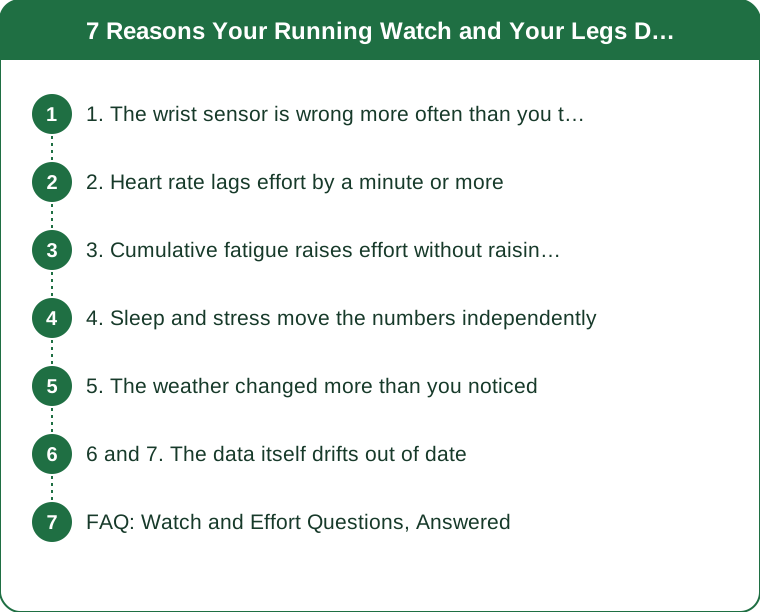
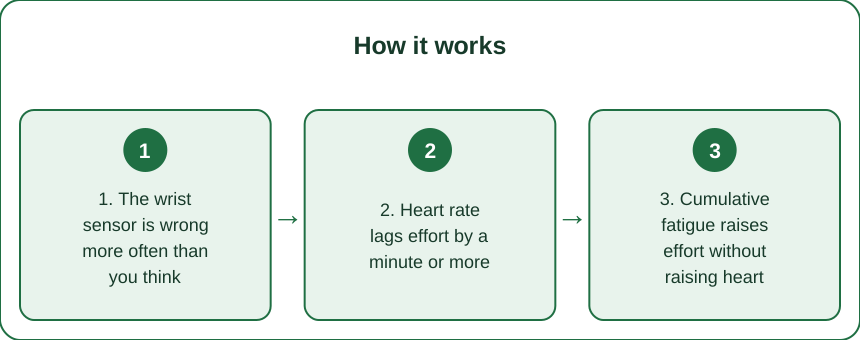
1. The wrist sensor is wrong more often than you think
Optical heart rate reads blood flow through skin, and cold constricts that flow. Autumn mornings are exactly the conditions where wrist readings are least reliable, which is why the first cool weeks produce so many strange graphs.
Cadence lock is the classic failure. The sensor can latch onto your step rate rather than your pulse, producing a suspiciously steady reading around 160 to 180 that has nothing to do with your heart.
Fit matters enormously. A loose strap, or one worn over the wrist bone, degrades the signal badly. Two fingers above the bone, snug enough not to slide.
A chest strap resolves almost all of this and is the single best purchase for anyone who actually uses the data.
2. Heart rate lags effort by a minute or more
Cardiac response is not instant. At the start of a run or after a pace change, heart rate takes up to two minutes to reach a steady state for that effort.
This makes short intervals nearly unreadable by heart rate. By the time the number reflects the effort, the interval is over.
It also explains the easy first mile that feels hard. Your legs are working before your cardiovascular system has caught up, which is precisely what a warm-up is for.
Use pace or power for short efforts and heart rate for long steady ones. They answer different questions.
3. Cumulative fatigue raises effort without raising heart rate
In an accumulated-fatigue state, heart rate can actually be suppressed while perceived effort climbs. This is one of the more counterintuitive findings and it catches out a lot of runners in a heavy training block.
A run that feels much harder than the numbers suggest, repeatedly, over a week or two, is worth taking seriously as a signal to reduce load.
Perceived effort is the more sensitive instrument here. It picks up accumulated fatigue earlier than heart rate does.
One hard-feeling run is noise. Five in a row is information.

4. Sleep and stress move the numbers independently
A short night raises perceived effort at any given pace and can raise or suppress heart rate depending on the individual.
Psychological stress has a measurable effect on both resting heart rate and perceived exertion, which is why a bad week at work produces bad-feeling runs at unchanged fitness.
Alcohol raises heart rate for a day or more and reduces sleep quality on top of it.
None of these are training problems, and treating them as such by pushing harder is how a rough week becomes a rough month.
5. The weather changed more than you noticed
Humidity affects effort more than temperature. A humid morning at 18 degrees can feel harder than a dry one at 24, and the heart rate reflects it while the pace does not.
Wind is invisible in the data. A headwind on the outbound leg costs meaningfully more effort at the same pace, and most watches do not record it.
The first cool mornings flatter the numbers. Heart rate drops at the same pace once the heat penalty lifts, which can make a genuinely hard effort look moderate.
Check the conditions before concluding anything about fitness from a single run’s data.
6 and 7. The data itself drifts out of date
6. GPS pace is noisier than it looks
Trees, buildings and cloud cover all degrade GPS accuracy, producing instantaneous pace readings that swing by 20 or 30 seconds per mile with no change in effort at all. Deep valleys and dense woodland are the worst offenders, and a watch reporting a sudden 30-second slowdown under a canopy is reporting the canopy.
Chasing instantaneous pace is how easy runs quietly become moderate ones. Lap pace or average pace is far more usable, and covering the screen entirely on easy days is more effective still.
Distance error also compounds on winding routes, because each recorded point cuts a corner. A run logged as three percent short changes every pace figure derived from it, which is enough to make a well-executed session look sloppy.
On a run where the numbers look wrong, trust the effort. Repeated across a training block, effort-based running produces more consistent easy days than pace-based running does, and easy-day discipline is the single biggest predictor of whether a build goes well.
7. You are fitter than the zones you set months ago
Zones drift out of date. A maximum or threshold heart rate estimated in spring may no longer describe you in September, and outdated zones make perfectly correct efforts look wrong on the screen.
Formula-based zones are estimates with wide individual variation. The common age-based maximum formula carries a large standard deviation, which means it is meaningfully wrong for a substantial share of people — potentially by 10 beats or more in either direction.
Retest rather than adjust by feel. A field test in normal conditions, repeated every few months, keeps the zones useful. Estimating new zones from a few runs that felt easy is how people end up with zones that flatter them.
Or use effort as the primary signal and heart rate as the check. For most recreational runners that ordering produces better training than the reverse, because effort automatically accounts for heat, sleep, stress and fatigue while a fixed number does not.
If the mismatch comes with chest discomfort, unusual breathlessness, dizziness or palpitations, stop and seek medical advice. That is outside anything on this list and is not a data question.
FAQ: Watch and Effort Questions, Answered
Should I stop looking at my watch?
Many runners improve their easy-day discipline by covering the screen and reviewing data afterwards. The data is useful in review and distracting in real time.
Which is more reliable, heart rate or perceived effort?
For steady runs over 20 minutes, they usually agree. When they disagree persistently, perceived effort is the better guide for adjusting training load.
Is a chest strap really worth it?
If you make training decisions from heart rate, yes. Wrist optical sensors are convenient and least accurate in exactly the conditions — cold, intervals, weightlifting — where people most want precision.
TL;DR:
- Wrist sensors are least accurate in cold weather and during pace changes.
- Heart rate lags effort by up to two minutes, making short intervals unreadable.
- Accumulated fatigue raises perceived effort while heart rate stays flat or falls.
- Sleep, stress, humidity and wind all move effort without appearing in the data.
- Retest your zones seasonally, and trust your legs when the two disagree repeatedly.
The watch measures one thing. You measure everything else.
This is general information, not medical advice.
Keep Reading
This article is for general informational purposes only and is not medical advice. It is not a substitute for professional diagnosis or treatment. Always consult a qualified healthcare provider about your individual situation, especially before making significant changes to your diet or exercise routine.