7 Running Form Cues That Actually Help (Not the Ones You've Heard Before)
Quick Answer: The most effective running form cues are concrete and physical, not abstract — things like ‘quiet feet,’ ‘run tall,’ and ‘quick cadence’ give your body something specific to adjust, unlike vague advice like ‘relax more.’
Most running form tips (‘just relax,’ ‘run naturally’) sound nice but give your brain nothing to actually act on mid-run. Here are 7 cues runners consistently report actually changing something.

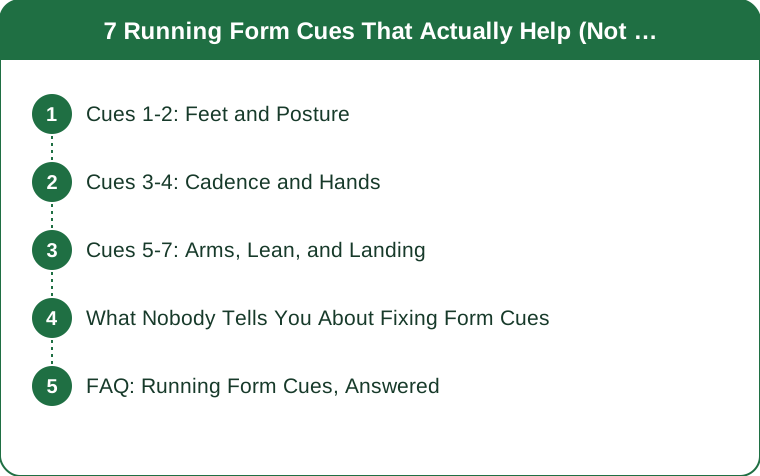
Cues 1-2: Feet and Posture
1. “Quiet feet”
Focus on landing softly enough that your footstrike makes minimal sound. This single cue naturally shortens overstride and increases cadence without you having to think about either directly — loud, slapping footfalls are almost always a sign of landing too hard, too far in front of your body.
2. “Run tall”
Imagine a string pulling the crown of your head toward the sky. This counters the slumped, hunched posture that creeps in during fatigue, and an upright torso lets your lungs expand fully — slouched posture literally restricts breathing capacity.
Cues 3-4: Cadence and Hands
3. “Quick, light cadence”
Aim to feel like your feet are turning over quickly and lightly, roughly 170-180 steps per minute for most runners, rather than covering ground with long, slow strides. Quicker cadence reduces the impact force per step, which is linked to lower injury rates.
4. “Hands like you’re holding a chip you don’t want to break”
Loosely cupped hands, not clenched fists. Tension in your hands travels up through your forearms and shoulders, and clenched fists are one of the most common hidden sources of upper-body tightness that wastes energy over long distances.

Cues 5-7: Arms, Lean, and Landing
5. “Elbows brushing your ribs”
Arms swinging too wide across your body wastes lateral energy that should be going forward. Keeping elbows closer to your sides keeps arm swing efficient and forward-focused, especially over the final miles of a longer run.
6. “Lean from the ankles, not the waist”
A slight forward lean helps use gravity to assist forward motion, but the lean should come from ankle angle, not bending at the hips. Bending at the waist instead just creates a slouch that restricts breathing and adds strain to the lower back.
7. “Land under your hips, not out in front”
This is the cue that fixes overstriding, one of the most common inefficiencies in recreational runners. Your foot should land roughly beneath your center of mass, not reaching out ahead of your body — reaching forward acts like a small brake with every single step.
What Nobody Tells You About Fixing Form Cues
Form cues work best on easy-paced runs, not hard efforts, because your brain has spare attention to spend on technique only when you’re not also managing pace and breathing effort. Trying to fix cadence during an interval workout usually fails — practice new cues on your easy days first, then let them carry over automatically once they’re ingrained.
FAQ: Running Form Cues, Answered
Should I try to fix all 7 cues at once?
No — pick one cue per run for 2-3 weeks until it feels automatic, then layer in the next. Trying to consciously manage all 7 at once usually backfires into stiff, overthought running.
Will these cues slow me down while I’m learning them?
Slightly, at first, since conscious attention takes some fluidity away — but within 2-3 weeks the cue becomes automatic and any pace cost disappears.
Do these cues apply to trail running too?
Most do, though ‘land under your hips’ needs more flexibility on technical terrain where foot placement is dictated by the trail surface itself.
TL;DR:
- Concrete physical cues beat vague advice like ‘just relax’
- ‘Quiet feet’ and ‘land under your hips’ fix overstriding, the most common inefficiency
- Quick, light cadence (170-180 spm) reduces impact force per step
- Practice one cue at a time, on easy runs, until it becomes automatic
Pick the cue that matches your biggest form issue and give it 2-3 weeks before adding another.
Keep Reading
This article is for general informational purposes only and is not medical advice. It is not a substitute for professional diagnosis or treatment. Always consult a qualified healthcare provider about your individual situation, especially before making significant changes to your diet or exercise routine.