7 Running Mistakes That Are Slowing You Down Without You Knowing
Quick Answer: The most common speed-draining running mistakes are overstriding, poor arm swing, holding tension in the shoulders, inconsistent pacing, under-fueling, skipping strength work, and ignoring cadence — most are fixable with small, specific adjustments rather than more mileage.
You’re putting in the miles. Your times aren’t reflecting the effort. Often the gap isn’t fitness — it’s a handful of small habits quietly working against you every single run.

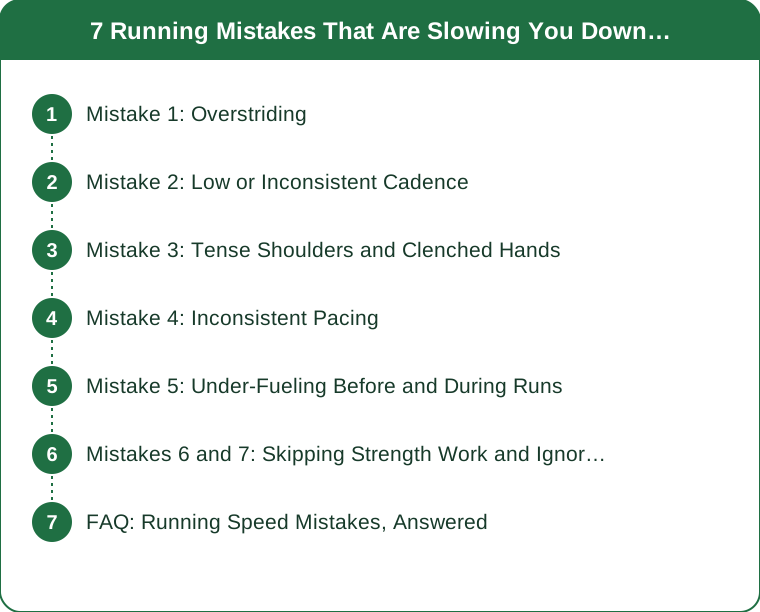
Mistake 1: Overstriding
Landing with your foot too far ahead of your body creates a braking effect with every step, which wastes energy and increases impact stress on your knees and shins.
The fix is aiming for your foot to land closer to under your hips rather than reaching forward — most runners find this happens naturally when cadence increases slightly.
Mistake 2: Low or Inconsistent Cadence
A cadence below roughly 170 steps per minute is associated with overstriding and less efficient running for most recreational runners, though ideal cadence varies by height and pace.
Running to a metronome app at a slightly higher cadence than your natural rhythm for short intervals can retrain this without consciously thinking about stride length the entire run.
Mistake 3: Tense Shoulders and Clenched Hands
Tension in the upper body wastes energy that should be going toward forward motion, and it tends to creep in most during the final stretch of hard runs when focus fades.
A quick shoulder-drop and hand-relax check every mile or so, especially late in a run, keeps this energy leak from compounding over longer distances.

Mistake 4: Inconsistent Pacing
Starting too fast and fading, or running every easy run at a hard effort, prevents the aerobic adaptations that actually build speed over time — easy runs need to feel genuinely easy to do their job.
Using heart rate or a conversational pace test (able to speak in full sentences) for easy days keeps effort honest, reserving harder efforts for dedicated speed sessions.
Mistake 5: Under-Fueling Before and During Runs
Running on empty, especially for runs over 60-90 minutes, forces your body to rely on less efficient fuel sources, which shows up as unexplained fatigue and slower splits later in a run.
A small carb-focused snack 30-60 minutes before longer runs, and fueling during runs over 75-90 minutes, keeps energy more stable throughout.
Mistakes 6 and 7: Skipping Strength Work and Ignoring Recovery
Mistake 6: Skipping Strength Training
Running-only training leaves stabilizing muscles underdeveloped, which limits how efficiently force transfers with each stride and raises injury risk over time. Just two 20-30 minute strength sessions weekly, focused on glutes, hips, and core, measurably improves running economy within 6-8 weeks for most runners.
Mistake 7: Ignoring Recovery Between Hard Efforts
Stacking hard workouts without adequate easy days in between prevents the adaptation that actually makes you faster — improvement happens during recovery, not just during the hard effort itself. Most effective plans follow a hard-easy-easy pattern rather than hard-hard-easy, giving the body enough recovery time to absorb each hard session’s benefit.
FAQ: Running Speed Mistakes, Answered
Which of these mistakes matters most to fix first?
Cadence and pacing tend to have the biggest immediate impact, since they affect nearly every run, while strength training benefits build more gradually over weeks.
Can I fix more than one of these at a time?
It’s usually more effective to focus on one adjustment at a time (like cadence) for 2-3 weeks before layering in another, rather than overhauling everything at once.
Will fixing form mistakes alone make me faster without more training?
Form fixes reduce wasted energy, but real speed gains still require consistent training — think of these fixes as removing friction, not replacing the training itself.
TL;DR:
- Overstriding, low cadence, and upper body tension quietly waste energy every run
- Inconsistent pacing on easy days prevents the aerobic adaptations that build real speed
- Under-fueling and skipping strength work both limit performance in less obvious ways
- Fix one habit at a time over a few weeks rather than trying to overhaul everything at once
Pick just one of these seven to focus on for the next two weeks — small, specific fixes compound faster than they seem like they would.
Keep Reading
This article is for general informational purposes only and is not medical advice. It is not a substitute for professional diagnosis or treatment. Always consult a qualified healthcare provider about your individual situation, especially before making significant changes to your diet or exercise routine.