Couch to 5K Plan: 9 Weeks, Week by Week - and the 7 Places People Quit
Quick Answer: A couch to 5K plan takes 9 weeks, three runs per week, and moves you from 60-second run intervals to 30 continuous minutes. The structure is not the hard part - the dropout points are. Most people quit in week 3, week 5, or week 7, and each of those has a specific, fixable cause.
The plan itself is public and free and has been for two decades. What nobody hands you alongside it is the map of where it goes wrong. Here’s the week-by-week structure with the seven failure points marked.

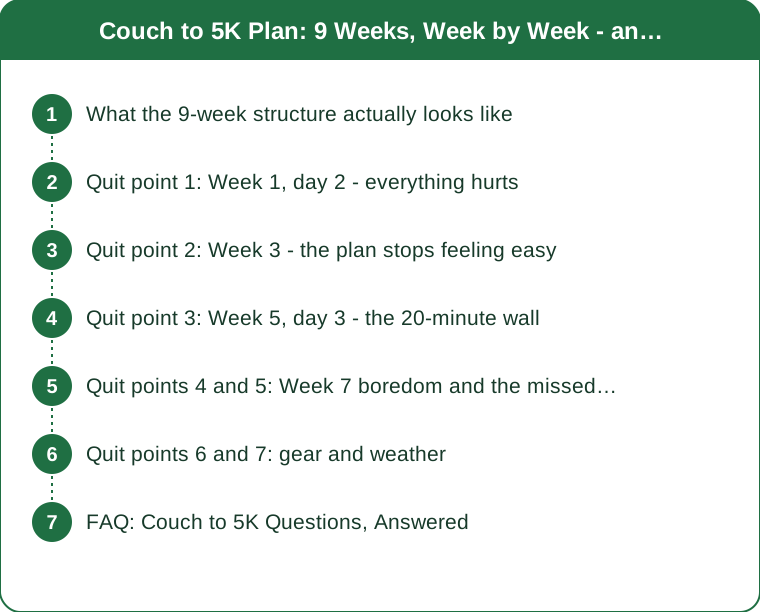
What the 9-week structure actually looks like
Three runs a week, never on consecutive days, each starting with a 5-minute brisk walk warm-up.
- Week 1: 60s run / 90s walk x 8
- Week 2: 90s run / 2min walk x 6
- Week 3: 90s run, 90s walk, 3min run, 3min walk x 2
- Week 4: 3min run, 90s walk, 5min run, 2.5min walk, 3min run, 90s walk, 5min run
- Week 5: three different sessions, ending with a 20-minute continuous run
- Week 6: back to intervals, then a 25-minute continuous run
- Week 7: 25 minutes continuous, three times
- Week 8: 28 minutes continuous, three times
- Week 9: 30 minutes continuous - which is 5K for most people
Total time commitment is roughly 90 minutes a week. That’s the entire ask.
Quit point 1: Week 1, day 2 - everything hurts
The most common dropout isn’t a week in. It’s the second session, when shins, calves, and hips are sore in ways that feel like injury.
It usually isn’t. Delayed onset soreness peaks 24-48 hours after a new stimulus and is a normal response to the first running your legs have done in years.
The fix is one word: slower. Almost every beginner runs their run intervals at roughly 5K race effort, when the plan assumes conversational effort. If you can’t speak a full sentence during a run interval, you’re going too fast - and the plan will break you long before week 9.
Sharp, localized, one-sided pain is different from general soreness and is worth a professional opinion.
Quit point 2: Week 3 - the plan stops feeling easy
Week 3 introduces the first 3-minute run block, and the jump from 90 seconds feels enormous. This is where the beginner’s honeymoon ends.
The cause is usually week 1 and week 2 were run too fast, so week 3 arrives with no aerobic base and legs that never fully recovered.
The fix that works: repeat week 3 entirely. Not as failure - as design. Repeating a week is the single most useful modification to this plan and nobody tells beginners it’s allowed. A 10-week or 12-week couch to 5K finishes; a rushed 9-week one often doesn’t.

Quit point 3: Week 5, day 3 - the 20-minute wall
Week 5 ends with a 20-minute continuous run, up from 8 minutes of continuous running two days earlier. It’s the steepest jump in the entire plan and it’s where the largest single group of people stop.
Three things make it survivable:
Slow down by another 30 seconds per kilometre than feels right. Twenty minutes at a boring pace is achievable; twenty minutes at week-1 pace is not.
Break it mentally into 4 x 5 minutes. The number 20 is intimidating. Five, four times, is not.
Accept that it will feel bad around minute 12. It does for almost everyone, and it passes by minute 15. Knowing that in advance is most of the battle.
Quit points 4 and 5: Week 7 boredom and the missed-week spiral
Week 7 is three identical 25-minute runs. No new challenge, no novelty, just repetition - and motivation built on novelty runs out here. The fix is to change the input rather than the plan: a new route, a podcast saved only for runs, or one run a week with company.
The missed-week spiral is the other killer, and it can hit at any point. Life happens, you miss five days, and then you feel you’ve lost everything and start over from week 1 - or don’t start at all.
The actual rule: miss up to a week, repeat your last completed week and continue. Miss two to three weeks, drop back one week. Miss longer, restart from week 3 rather than week 1. You keep far more fitness than you think.
Quit points 6 and 7: gear and weather
Gear ends more beginner running than injury does, and it splits two ways. Some people buy nothing and run in worn-out shoes with no support, which turns normal soreness into genuine shin pain. Others buy everything and treat the purchase as the accomplishment.
The honest minimum: running shoes that aren’t worn flat, and clothing that doesn’t chafe. That’s it. Get shoes fitted somewhere that watches you walk, if you can.
Weather is quit point seven, and August is one of its two peaks. Humid late-summer running is genuinely harder - your pace at the same effort can be 30-60 seconds per kilometre slower in high humidity, and beginners read that as losing fitness. It isn’t. Run by effort, not pace, run early or late, and expect the transition into cooler autumn weeks to feel like a free upgrade.
FAQ: Couch to 5K Questions, Answered
How fast should I be running the intervals?
Slow enough to hold a conversation. If you can’t, you’re running the plan wrong regardless of what the stopwatch says.
Can I do four runs a week to finish faster?
Not recommended. The rest days are where adaptation happens, and the most common cause of beginner injury is frequency added too early. Add a walk or a swim instead.
What if I can’t finish 30 minutes at week 9?
Repeat week 8, then try again. The plan is a template, not a test. A large share of people who finish take 11 or 12 weeks.
Is 30 minutes actually 5K?
For many beginners it’s closer to 4 to 4.5K, and that’s fine. Time on feet is the goal of the plan; the distance follows within a few weeks of finishing.
TL;DR:
- 9 weeks, 3 runs a week, 90 minutes total per week
- Run intervals should be conversational pace - this fixes most problems before they start
- Repeating a week is a feature, not a failure; a 12-week finish beats a 9-week quit
- The 20-minute run in week 5 is the steepest jump; break it into 4 x 5 mentally
- Miss time? Repeat your last completed week rather than restarting
The plan works. The people who finish it are not the fittest starters - they’re the ones who went slow enough in week 1 to still be there in week 7.
Keep Reading
This article is for general informational purposes only and is not medical advice. It is not a substitute for professional diagnosis or treatment. Always consult a qualified healthcare provider about your individual situation, especially before making significant changes to your diet or exercise routine.