How to Breathe While Running (So You Don't Gas Out)
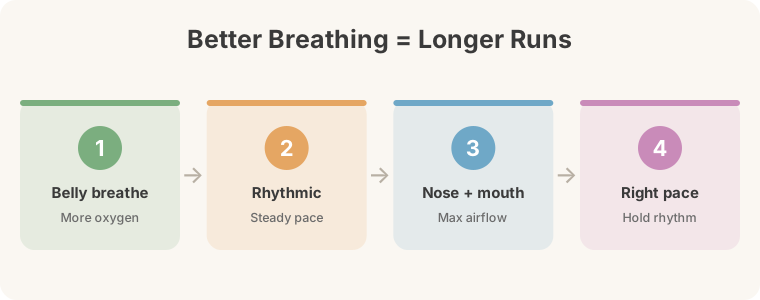
Quick Answer: Breathe from your belly, not your chest, and sync your breath to your steps — a 3:2 rhythm (inhale for 3 footfalls, exhale for 2) works well at easy pace, dropping to 2:1 when you speed up. Use your nose and mouth; “nose only” is a myth for running. If you can’t hold the rhythm, you’re running too fast. Slow down until you can.
You felt great for ninety seconds. Then your breathing fell apart, your chest got tight, and you concluded — as most people do — that you’re simply not a runner.
You might just be breathing wrong. It’s the most fixable problem in running and nobody teaches it.

Why Does Breathing Fall Apart Two Minutes Into a Run?
Because most people default to chest breathing — shallow, fast, and using maybe the top third of their lung capacity.
Your diaphragm is the big muscle that should do the work. When you breathe shallowly, it barely moves, so you compensate by breathing faster instead of deeper. Fast shallow breaths mean more air moving in and out with less oxygen actually reaching your blood, which is a losing exchange. Your body reads the shortfall as alarm and your breathing gets more frantic, which makes it worse.
That’s the spiral. It feels like a fitness ceiling and it’s usually a technique problem.
The Techniques That Actually Help
1. Breathe From Your Belly
How to check: lie on your back, one hand on your chest, one on your stomach. Breathe normally. The stomach hand should rise more than the chest hand. If it doesn’t, you’re chest breathing.
Practice for 5 minutes a day lying down, then while sitting, then while walking, then on easy runs. It takes about two weeks to become automatic, and it’s the highest-leverage change on this list.
2. Try Rhythmic Breathing (3:2 or 2:1)
Sync your breath to your footfalls. Inhale for 3 steps, exhale for 2 — that’s a 3:2 rhythm, and it suits easy conversational pace for most runners.
As pace increases, shift to 2:1 (inhale 2 steps, exhale 1). For hard efforts or hills, 1:1 is fine.
The odd-numbered pattern does something clever: because the total cycle is 5 steps, you exhale on alternating feet rather than always the same one. Exhaling is when your core is least stable, so alternating spreads that stress across both sides instead of loading one side repeatedly.
3. Use Your Nose AND Your Mouth
Forget nose-only breathing for running. Your nose alone can’t move enough air once you’re above easy effort — your mouth delivers far more volume, and volume is what you need. Breathe through both. Nose-only breathing is a legitimate practice for low-intensity training, but as a rule for all running it just makes you slower and more uncomfortable.
4. Slow Down Until the Rhythm Holds
This is the one nobody wants to hear. If you cannot maintain your breathing rhythm, you are running too fast. Full stop.
The practical test: at your easy pace you should be able to speak a full sentence without gasping. Most beginners run their easy runs far too fast, which is precisely why the breathing collapses at minute two.
Slow down. Speed arrives later and it arrives on top of a base you can only build at easy effort.
5 Mistakes Everyone Makes With Running Breath
1. Breathing through the chest. Covered above and it’s the root cause of most of the rest.
2. Holding tension in the shoulders. Hunched, tight shoulders compress the ribcage. Drop them, keep hands loose, and shake your arms out mid-run when you notice.
3. Only thinking about the inhale. A full exhale is what makes room for the next inhale. If you’re only ever partially emptying, you’re breathing on top of stale air. Focus on pushing the exhale out completely.
4. Ignoring the rhythm on hills. Rhythm matters most exactly when it’s hardest to hold. Shorten your stride and shift to a 2:1 rather than abandoning the pattern.
5. Running too fast on easy days. The single biggest cause of “I can’t breathe when I run.”

Beating the Dreaded Side Stitch
That sharp cramp under the ribs is common and usually preventable.
Why it happens: the leading theory is stress on the diaphragm and the connective tissue supporting your abdominal organs, aggravated by shallow breathing and by exhaling on the same foot every stride.
How to prevent it: breathe deeply from the belly, use an odd-numbered rhythm so you alternate exhale feet, and avoid eating a large meal within 2 hours of running.
How to fix it mid-run: slow down, take 3–4 very deep belly breaths, and time your exhale to land on the foot opposite the stitch. Pressing gently on the spot while you exhale hard helps. Most stitches clear within a minute or two.
FAQ
What is the best breathing pattern for running?
A 3:2 rhythm — inhale for 3 footfalls, exhale for 2 — works well at easy pace, shifting to 2:1 as effort increases. The odd number matters because it alternates which foot you exhale on, which reduces the repeated one-sided stress associated with side stitches.
Should I breathe through my nose or mouth while running?
Both. Your nose alone can’t supply enough airflow above easy effort, and there’s no performance benefit to restricting yourself. Nose breathing has a role in deliberately low-intensity training, but for general running, use whatever moves the most air.
Why do I get out of breath so quickly when running?
Almost always because you’re running faster than your current aerobic fitness supports, often combined with shallow chest breathing. Slow to a pace where you can speak a full sentence, breathe from your belly, and the problem usually resolves within a couple of weeks.
TL;DR:
- Belly breathing beats chest breathing — practice 5 minutes a day lying down.
- Use a 3:2 rhythm at easy pace, 2:1 when working harder.
- Odd-numbered rhythms alternate your exhale foot and help prevent side stitches.
- Breathe through nose and mouth both; nose-only is a myth for running.
- If you can’t hold the rhythm or speak a sentence, you’re going too fast.
This article is for general informational purposes only and isn’t medical advice.
Keep Reading
This article is for general informational purposes only and is not medical advice. It is not a substitute for professional diagnosis or treatment. Always consult a qualified healthcare provider about your individual situation, especially before making significant changes to your diet or exercise routine.