Is 180 Steps Per Minute Really the 'Ideal' Running Cadence? Here's the Real Answer
Quick Answer: 180 steps per minute was observed as a rough average among elite runners in one small, older study — it’s not a universal target that applies to every runner regardless of height, pace, or running style. A more useful approach is increasing your own cadence by 5-10% if you’re noticeably overstriding, not forcing an exact 180 number.
The ‘180 spm’ rule gets repeated so often in running advice that it’s treated as an exact prescription. The original research behind it was far more limited and specific than the popular version of the claim suggests.

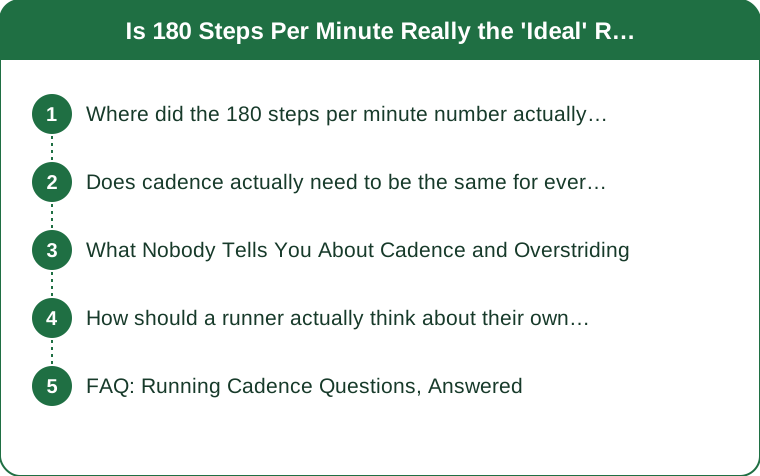
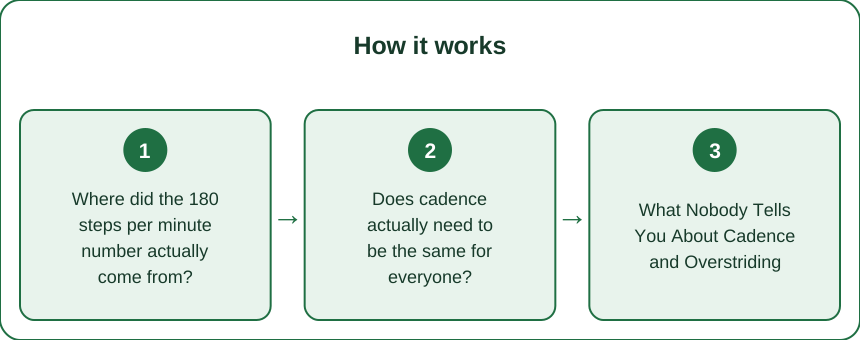
Where did the 180 steps per minute number actually come from?
The figure traces back to observations of elite runners at the 1984 Olympics, where a running coach noted many top competitors clustered around 180 steps per minute regardless of race distance. It was an observational pattern among elite athletes, not a controlled study proving 180 is optimal for all runners.
Elite runners also tend to be a specific population — highly trained, often within a certain height and build range — which limits how directly that observation generalizes to recreational runners of varying builds and experience levels.
Does cadence actually need to be the same for everyone?
No — cadence naturally varies with height, leg length, pace, and running style. Taller runners with longer legs often have naturally lower cadence at a given pace than shorter runners, without this being inherently less efficient.
Cadence also increases naturally with running speed for most people — comparing an easy-run cadence to a race-pace cadence, or comparing your cadence to a runner of a very different build, isn’t a fair or useful comparison.

What Nobody Tells You About Cadence and Overstriding
Here’s the part that actually matters more than hitting a specific number: cadence is most useful as an indirect fix for overstriding (landing with the foot far ahead of the body’s center of mass), which is linked to increased impact stress and injury risk. Increasing cadence slightly often naturally shortens stride and reduces overstriding, without runners needing to think about foot placement directly.
This means the goal isn’t ‘180 exactly’ — it’s often ‘a modest cadence increase from your own current baseline’ if overstriding is a real issue, which is a very different, more personalized target.
How should a runner actually think about their own cadence?
Measure your own natural cadence at an easy pace first (many running watches track this automatically), rather than starting from an assumption that 180 is the target. If you’re not experiencing overstriding-related pain and your cadence is naturally lower than 180, there’s no strong evidence you need to force a change.
If overstriding or related injury issues are present, a gradual 5-10% cadence increase, practiced consistently over several weeks, is generally recommended over an abrupt jump to a specific target number.
FAQ: Running Cadence Questions, Answered
Is a cadence below 180 automatically a problem?
No — many efficient, uninjured runners have a natural cadence in the 160-170s range, particularly taller runners; the number alone isn’t diagnostic of a problem.
How much should cadence change if overstriding is an issue?
Most coaching guidance suggests a gradual 5-10% increase from your own baseline, rather than jumping straight to 180 regardless of your starting point.
Does cadence change with running speed?
Yes — cadence naturally rises somewhat at faster paces for most runners, so comparing an easy-run cadence to a race-pace cadence isn’t a meaningful comparison.
TL;DR:
- The 180 spm figure came from limited elite-runner observation, not a controlled study proving it’s universally ideal
- Cadence naturally varies by height, leg length, pace, and running style
- Cadence matters most as an indirect fix for overstriding, not as a fixed target number
- A gradual 5-10% increase from your own baseline is more useful than forcing exactly 180
Cadence advice works better as ‘adjust from your own baseline if overstriding is a real issue’ than as a universal number to chase.
Keep Reading
This article is for general informational purposes only and is not medical advice. It is not a substitute for professional diagnosis or treatment. Always consult a qualified healthcare provider about your individual situation, especially before making significant changes to your diet or exercise routine.