Running Cadence: The Simple Tweak That Prevents Injury
You finish an easy run and your knees are grumbling. Nothing dramatic — just that dull ache that shows up around mile three and hangs around for the rest of the evening.
You’ve probably blamed your shoes. It might be your steps per minute.
Quick Answer: Cadence is how many steps you take per minute while running. Many recreational runners land around 150–160 and over-stride, hitting the ground hard on an extended leg. Nudging cadence up by about 5% at a time — using a metronome app or a beat-matched playlist — shortens your stride, softens your landing, and reduces load on your knees and hips. Give each 5% increase two to three weeks to feel normal.

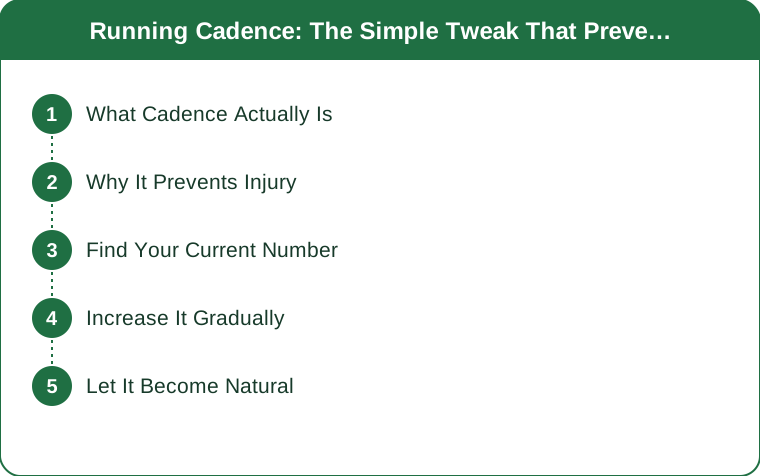
What Is Running Cadence, Exactly?
Steps per minute. Both feet, counted together. That’s the whole definition.
Where it gets interesting is what a low cadence implies about your stride. If you’re taking relatively few steps per minute at a given pace, each of those steps has to cover more ground. That means your foot is landing further out in front of your center of mass — the pattern usually called over-striding.
Picture what that looks like at the moment of contact: leg extended, heel out ahead of you, knee fairly straight. Your body is essentially putting on a small brake with every step, and the force from that landing travels up through your ankle, knee, and hip. Multiply by roughly 1,500 steps per mile and you can see why the ache is cumulative rather than sudden.
A lot of recreational runners sit somewhere in the 150s. The often-quoted target of 180 comes from observations of elite distance runners and gets treated as a magic number more often than it should be — it isn’t one. Cadence naturally varies with your height, leg length, and how fast you’re going. Which brings us to the useful version of this idea.
Why Does a Higher Cadence Reduce Injury Risk?
Because it changes where your foot lands relative to your body, not because faster steps are inherently better.
Take more steps per minute at the same pace and each step gets shorter automatically — you can’t cover the same distance with more steps any other way. Shorter steps mean your foot lands closer to underneath you instead of way out front. Three things follow:
- Less braking force. You stop putting on the brake with every step, which is where a large share of the impact load comes from.
- A more bent knee at contact. A slightly flexed knee absorbs shock far better than a straight one. Your leg becomes a spring instead of a pole.
- Less vertical bouncing. Longer strides tend to come with more up-and-down movement, and everything that goes up lands with more force.
The result is a lighter, quieter landing. That’s actually the simplest self-check available: if you can hear your own footfalls slapping the pavement, your cadence is probably low. Quiet running and efficient running correlate closely.
Worth being straight about the limits: cadence adjustment is one useful variable among several, and it isn’t a cure for every running injury. Sudden mileage jumps, weak hips and glutes, worn-out shoes, and running through pain all cause problems that no cadence tweak will fix. But among the things you can change in a single run, it’s one of the highest-leverage.

How Do You Measure Your Current Cadence?
Two ways, and you should do this before changing anything. You can’t improve what you haven’t measured, and you need a baseline to calculate your 5% from.
The watch method. Most running watches track cadence automatically. Check the average for an easy-paced run — not a hard one, since cadence rises with effort and a race-pace number will mislead you. Note that some watches report steps for one foot only (roughly 75–90) and others report both (roughly 150–180). Make sure you know which you’re looking at.
The manual method. Run at your normal easy pace, set a timer for 60 seconds, and count every time your right foot lands. Multiply by 2. Do this two or three times over the course of the run and average it — a single count can be off by a few steps.
Do the count on flat ground. Hills change cadence significantly in both directions.
How Do You Actually Increase Your Cadence?
Slowly, in 5% steps, with an external beat.
The math. If your baseline is 160, your first target is 168 (160 × 1.05). Not 180. Jumping straight from 160 to 180 is a 12% change, and large jumps feel forced, burn extra energy, and often just get abandoned three runs in.
Use a metronome app or a beat-matched playlist. Set the metronome to your target — 168 beats per minute — and land a foot on each beat. Most people find music easier to sustain than a click; playlists sorted by BPM are easy to find, and 168 BPM is a very well-populated tempo range.
Practice in intervals, not whole runs. Don’t try to hold a new cadence for 40 minutes on day one. Run 5 minutes at the new cadence, 5 minutes at your natural one, and repeat. Over two to three weeks, extend the new-cadence blocks.
Think “quicker and lighter,” not “faster.” This is the cue that clicks for most people. You’re not trying to run faster — you’re taking quicker, smaller steps at the same speed. If your pace jumps significantly, you’ve turned a form drill into a hard workout.
Give each increment 2–3 weeks before the next one. Your nervous system needs time to make the new pattern automatic. When you catch yourself running at the new cadence without the metronome on, that’s your signal you’re ready to nudge again.
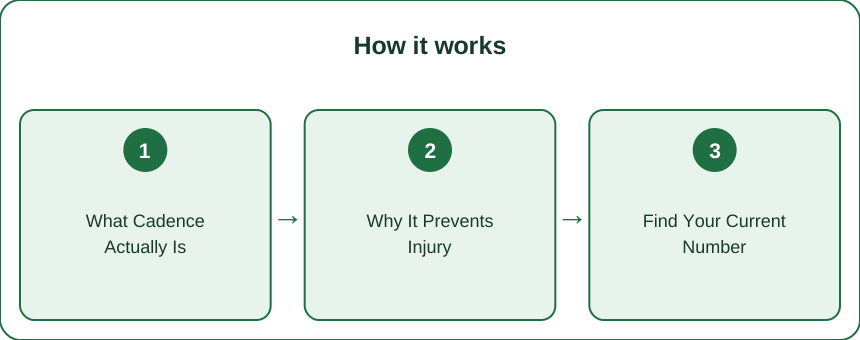
5 Mistakes Everyone Makes When Changing Cadence
1. Chasing 180 as a universal target. It’s an average from elite runners, not a prescription. A tall runner at an easy pace may be perfectly efficient in the low 160s. Your baseline plus 5% is a better goal than someone else’s number.
2. Making the jump all at once. Big changes feel unnatural, cost extra energy, and rarely stick. Increments of 5% feel almost boring — which is exactly why they work.
3. Accidentally running harder. A new cadence should be practiced at easy pace. If your heart rate is climbing, slow down and keep the step rate.
4. Measuring cadence during a hard effort. Cadence naturally rises with speed. A baseline taken during a tempo run will be inflated, and you’ll build your targets on a bad number.
5. Expecting cadence to fix an injury you already have. If something hurts right now, cadence work is a supporting change at best. Persistent knee, hip, or shin pain — especially pain that worsens during a run or lingers the next day — is worth a visit to a sports physio or physician before you keep training through it.
FAQ
What is a good running cadence?
There isn’t one number for everyone. Cadence varies with height, leg length, and pace, and elite runners land near 180 largely because they’re moving fast. The more useful framing is relative: find your own baseline at easy pace and work up in 5% steps if you’re over-striding, rather than aiming at a fixed target.
How long does it take to permanently change your cadence?
Roughly two to three weeks per 5% increment for the new pattern to start feeling automatic, and a couple of months for a larger change to become your genuine default. You’ll know it’s stuck when you find yourself holding the new cadence on a run where you forgot to turn the metronome on.
Will increasing my cadence make me a faster runner?
Not directly — you’re taking shorter steps at the same speed, so the pace stays put. What it can do is reduce braking forces and wasted vertical movement, which makes your running more economical over time, and reduce injury risk. The fastest runners are usually the ones who don’t have to stop training.
TL;DR:
- Cadence = steps per minute. Low cadence usually means over-striding: foot landing out in front, leg extended, heavy braking impact.
- Higher cadence shortens your stride so you land closer to underneath your body, with a more bent knee and less vertical bounce.
- Measure your baseline first at easy pace, on flat ground — count right-foot strikes for 60 seconds and double it.
- Increase by 5% at a time (160 → 168, not 160 → 180), using a metronome or BPM-matched playlist.
- Practice in 5-minute intervals, not whole runs, and give each increment 2–3 weeks.
- Cue it as “quicker and lighter,” not “faster.” If your pace jumps, you’ve made it a workout.
- Quiet feet are the free self-check. Slapping footfalls usually mean low cadence.
Keep Reading
This article is for general informational purposes only and is not medical advice. It is not a substitute for professional diagnosis or treatment. Always consult a qualified healthcare provider about your individual situation, especially before making significant changes to your diet or exercise routine.